
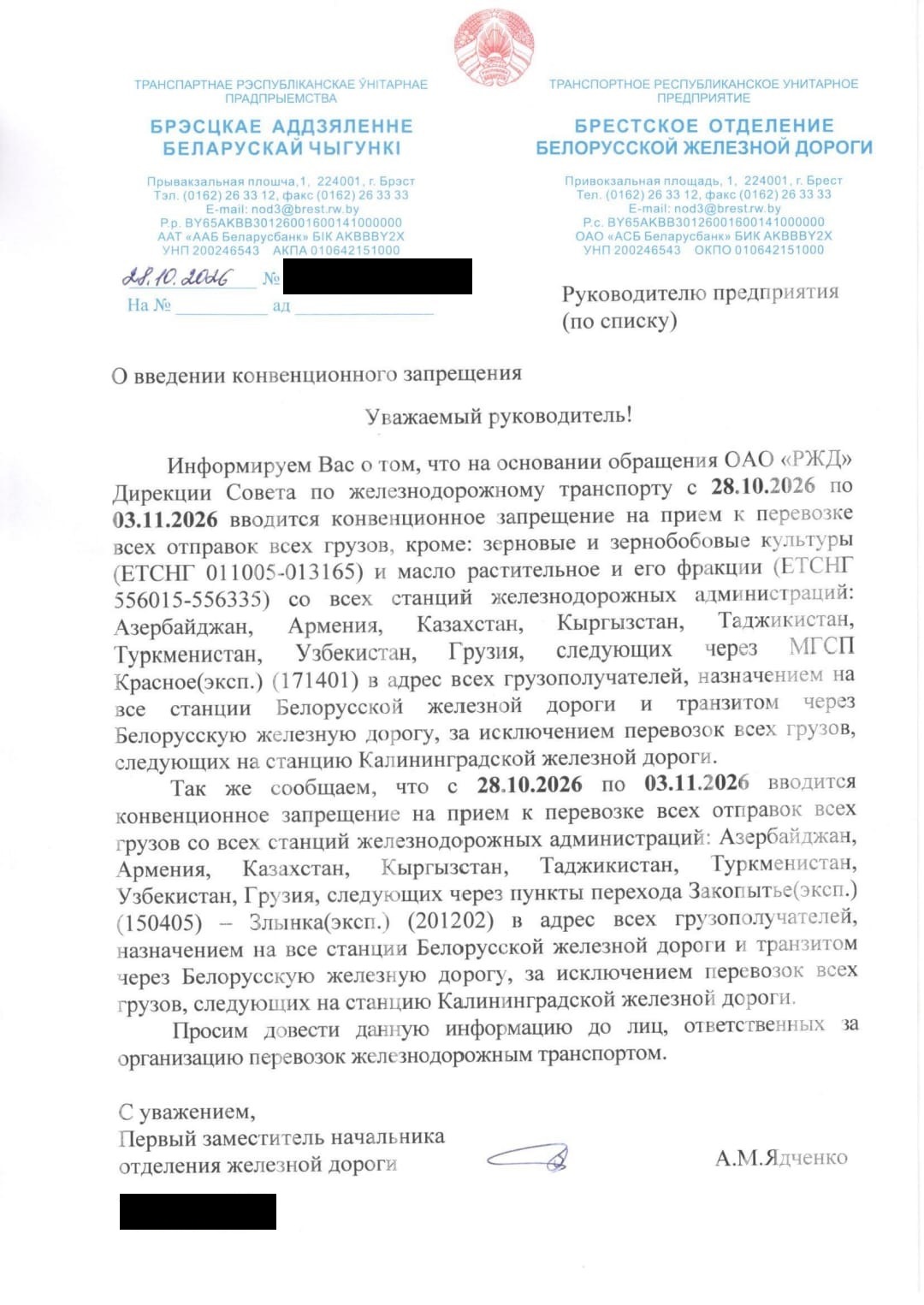
From October 28 to November 3, stations of the railway administrations of Azerbaijan, Armenia, Kazakhstan, Kyrgyzstan, Tajikistan, Turkmenistan, Uzbekistan and Georgia do not accept cargo for carriage to stations of the Belarusian Railway (BCh) or in transit through Belarus if it is routed via the Osinovka — Krasnoye or Zakopytye — Zlynka interstate border crossing (MGSP). Exceptions: grain and vegetable oil are accepted via Osinovka — Krasnoye, and cargo bound for the Kaliningrad Railway via both crossings. The conventional ban was introduced by the Directorate of the Council for Railway Transport of the CIS Member States at the request of Russian Railways (RZD). This follows from a letter from the Brest branch of BCh dated October 28, 2026, which is in our possession.
This is already the second known conventional ban via the Osinovka — Krasnoye crossing this October. The first one, from October 8 to 17, affected Poland, which is how it became known: Kazakh coal was shipped there along this route.
What Was Banned
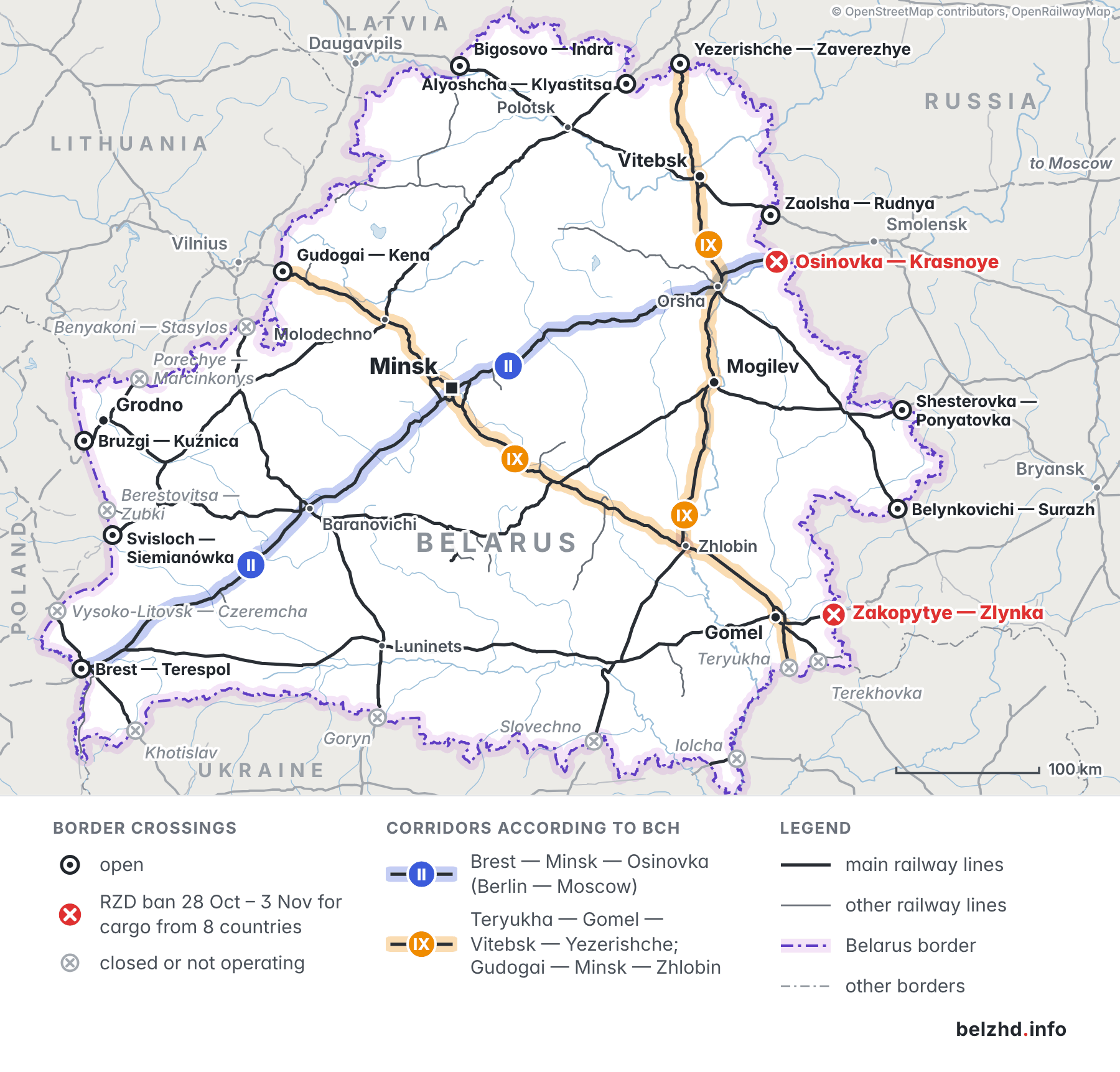
The letter contains two bans. The first concerns the Osinovka — Krasnoye crossing on the Moscow — Smolensk — Orsha line, which carries Pan-European Transport Corridor II. It prohibits accepting for carriage “all consignments of all goods” from all stations in Azerbaijan, Armenia, Kazakhstan, Kyrgyzstan, Tajikistan, Turkmenistan, Uzbekistan and Georgia bound for BCh stations or in transit through Belarus. The letter words the exceptions as follows: “except: cereals and pulses (ETSNG 011005-013165) and vegetable oil and its fractions (ETSNG 556015-556335),” as well as “excluding the carriage of all goods bound for a station of the Kaliningrad Railway.”
The second applies to the same consignments from the same eight countries via the Zakopytye — Zlynka crossing on the Bryansk — Unecha — Gomel line. There is no exception for grain and oil here: only cargo bound for the Kaliningrad Railway is accepted.
Russian stations are not on the list, so the ban does not apply to cargo from Russia. China is also not included: container trains from China to Europe are not directly affected by the letter.
For reference: a conventional ban is a standard tool for regulating railway transport on the 1520 mm gauge network. It is introduced when the destination or transit railway cannot cope with the train flow: originating stations stop accepting cargo for the specified route, and trains already en route are held at intermediate stations — “abandoned.” The initiator is the railway administration whose network is facing difficulties — in this case Russian Railways. The Directorate of the Council introduces the ban and notifies the other administrations.

What Happened in October
The Polish Chamber of Coal Traders (PIGSW) reported the first ban on October 8, 2026. The chamber published the text of a fax from the Council Directorate dated October 3, 2026: at the request of Russian Railways, no cargo and no empty cars were accepted for BCh stations via the Osinovka — Krasnoye crossing from October 8 to 17. The fax was addressed to the railways of nine countries, including Russia, and the ban covered cargo from stations in eight of them — the chamber did not specify which. BCh was not among the addressees.
For Poland, this primarily concerns coal. According to CCA analysts, 0.5 million tonnes of Kazakh coal went through this crossing by rail in all of 2025, and 0.9 million tonnes from January to September 2026, of which 0.3 million tonnes were in September alone. On October 28, the Polish portal wnp.pl reported that deliveries of Kazakh coal to Poland have been disrupted since early October, and it is unknown whether transit resumed after October 17, 2026. Polish Energy Minister Miłosz Motyka said he sees no risk of coal shortages for utility-scale power generation.
The new ban is structured differently. It lists transit through Belarus separately and does not mention empty cars, but it adds exceptions for grain, vegetable oil and cargo bound for Kaliningrad. Coal is not among the exceptions. In addition, the Zakopytye — Zlynka crossing has been added to Osinovka — Krasnoye.
Explaining the importance of the Osinovka — Krasnoye crossing, the Polish chamber also mentioned other Russia — Belarus crossings, including Zakopytye — Zlynka, but noted that their capacity is lower. Now the ban applies there too. The other five crossings with Russia (Zaolsha — Rudnya, Yezerishche — Zaverezhye, Alyoshcha — Klyastitsa, Shesterovka — Ponyatovka and Belynkovichi — Surazh) are not mentioned in the letter, and there are no restrictions on them yet.
First Theory: Russian Railways Lacks Capacity
This autumn, the Russian Railways network is congested on its north-western routes: because of disruptions at Black Sea ports, Russia is redirecting exports to the Baltic. As Marine Insight reports, grain shipments from Russia’s Black Sea and Sea of Azov ports fell from 1.39 million tonnes in August to 201,000 tonnes in September. According to the industry portal TKS, Baltic ports handled more than 1.2 million tonnes of grain in September, compared with 47,000 tonnes a year earlier, and another 875,000 tonnes in the first 20 days of October. Market participants report a build-up of cars, acceptance restrictions and delays of at least three days even for priority grain.
Russian Railways said the infrastructure on these routes “is operating at maximum load”: locomotives and locomotive crews have been redeployed there, and carrying capacity is allocated under the non-discriminatory access rules. When line capacity falls short, these rules set the order in which shipments are carried. Exports usually come last, but according to Kommersant, since October 1 grain on the north-western routes, including export grain, has been moved to the third priority category. Under intergovernmental agreements, Kazakh transit coal is in the fourth.
Coal and Kazakh cargo have been hit by the restrictions. According to the minutes of a meeting at Russia’s Ministry of Transport, seen by Kommersant, Russian Railways planned to cut coal shipments to the October Railway by 80% in October, and, according to the newspaper, October requests for the transit of Kazakh coal via Baltic ports are not being approved. As early as October 1, Kazakhstan Temir Zholy (KTZ) said that all October requests from Kazakh grain exporters for transit through Russia to the Baltic states had been rejected. Zeynolla Abdumanapov, head of the KazGrain grain exporters’ association, said there is no official ban on transit, but Kazakh cargo has long been given lower priority. Russian Railways itself does not comment on its shipment plans for specific routes.
This theory is consistent with the fact that Kazakh cargo has also been turned away on other routes since early October. It also explains the exception for Kaliningrad: the region is an exclave, and cargo has to get there whatever the restrictions. But there is a mismatch: it is the route to the Baltic ports that is overloaded, while the Osinovka — Krasnoye and Zakopytye — Zlynka crossings lead to Belarus. A link is possible through the locomotives and crews redeployed to the North-West, but there is no direct confirmation of this. Nor does this theory explain why even grain is not accepted via Zakopytye — Zlynka.
Second Theory: Attacks on the Line to Zlynka
The Zakopytye — Zlynka crossing is BCh’s gateway from the Bryansk — Unecha — Novozybkov — Gomel line. Since spring, drones have repeatedly attacked this section and neighboring lines, the track has been blown up, cars have derailed, and traffic has been interrupted more than once. Below are just some of the known incidents:
- May 21 — a drone hit a shunting locomotive at Unecha station, killing three Russian Railways employees. From May 30 to June 5, BCh did not dispatch freight trains via the Belynkovichi — Surazh crossing and routed them via Orsha and the Osinovka — Krasnoye crossing instead.
- May–June — locomotive crews of the Gomel depot often refused to take freight trains onto the Unecha — Bryansk section, and the share of Russian Railways crews on the Gomel — Bryansk run exceeded 90%.
- September 1 — according to our sources, the track at Unecha station was blown up, and the station was temporarily closed. Train No. 301 Adler — Minsk was diverted via Krichev and Mogilev and arrived 247 minutes late.
- September 27–28 — 18 empty gondola cars derailed in the Unecha district, temporarily suspending traffic on the Unecha — Zlynka section.
- October 10 — drones struck a railway bridge in the Vygonichi district, damaging the track and interrupting traffic on the Bryansk — Unecha — Gomel section. The Minsk — Adler train was diverted via the Smolensk line.
- October 13 — according to the Moscow Railway, train No. 85/86 Novozybkov — Moscow runs only as far as Unecha, from where passengers continue by bus, and train No. 301/302 Minsk — Adler runs on an alternative route.
- October 25 — on the Novozybkov — Zlynka section, a drone hit the diesel locomotive of a freight train that, according to the Bryansk governor, was traveling from Bryansk to Gomel. According to the Moscow Railway, the driver was killed. According to our information, since then even Russian Railways locomotive crews have been refusing to run trains on this section.
- October 28, the first day of the ban — at Klintsy station, a drone damaged the cab of the Unecha — Novozybkov railbus; no one was injured.
Loaded trains are generally kept off the Bryansk — Unecha — Gomel line. Since late 2022, military trains and cars carrying explosives have not been allowed through the Zakopytye — Zlynka crossing. Later, loaded oil tank trains from the Mozyr refinery were rerouted, primarily via the Osinovka — Krasnoye crossing. According to our information, mostly empty cars now pass through Zakopytye — Zlynka and Belynkovichi — Surazh, while oil products and other cargo go via Orsha.
This theory explains what the first one does not: why the ban at the Zakopytye — Zlynka crossing is stricter than at Osinovka — Krasnoye. There are few loaded trains on the southern line as it is, and for cargo from the eight countries the ban in effect formalizes what has already become practice. The load, meanwhile, has fallen on Osinovka — Krasnoye: oil trains were moved there, trains from the Belynkovichi — Surazh crossing were switched there in May, and in October the Minsk — Adler passenger train was diverted via the Smolensk line. No attacks on the Moscow — Smolensk — Krasnoye section were reported in 2026. The ban may have been needed to relieve this crossing.
But this theory does not explain everything either: the ban does not affect Russian cargo at either of the two crossings. So the question is more about priority: whose cargo goes first.
These theories are not mutually exclusive. Because of the attacks, loaded trains hardly use the southern route, the load has shifted to Osinovka — Krasnoye, and the Russian Railways network is already overloaded as exports are redirected to the Baltic. In this situation, Russian Railways decides whose cargo goes first, and cargo from other countries apparently is the first to be restricted: Kazakhstan has been complaining about this since early October.
Who This Affects
Belarus, first of all. In early June, KTZ reported that since the start of the year about 2.3 million tonnes had been carried by rail between Kazakhstan and Belarus, 19.6% more than a year earlier. Exports from Kazakhstan to Belarus doubled over four months, to 0.5 million tonnes.
BCh transit, which already shrank in 2025, is also hit. For the full year, container transit was 79.4% of the 2024 level, and exports of transport services fell by more than a quarter, to $93.4 million, with transit accounting for over 90% of that amount. In 2025, 11,389 freight trains crossed the Polish-Belarusian border, compared with 13,962 a year earlier.
Cargo bound for the Kaliningrad Railway also passes through Belarus, but the ban does not apply to it. From mainland Russia, the railway to the region runs in transit through Belarus and Lithuania. This is not the first time Kaliningrad has been exempted from restrictions. When Russia’s Federal Antimonopoly Service (FAS) doubled rail tariffs for shipments to Estonia, Latvia and Finland from June 1, 2026, shipments to stations of the Kaliningrad Railway and to Lithuania were exempt from the increase. And when Lithuania closed its road checkpoints on the border with Belarus in autumn 2025, the Kena rail checkpoint kept operating for transit to Kaliningrad.
What’s Next
The ban is in effect until November 3; whether it will be extended is unknown. In 2025, the Council for Railway Transport closed terminals in Russian ports to Kazakh coal for several days at a time: first in Vyborg, then several times in Ust-Luga. By August 2025, The Moscow Times had counted five such restrictions.
On October 16, delegations from BCh and the Moscow Railway, led by the heads of the two railways, Valery Verenich and Pavel Ivanov, met in Smolensk. The official BCh statement said the parties discussed “issues of developing passenger and freight transport”; it said nothing about restrictions or attacks on the Bryansk — Gomel line. According to our information, the attacks were in fact the main topic of the meeting. Both crossings now covered by the ban are on the Moscow Railway.
According to some reports, the question of temporarily closing the Zakopytye — Zlynka and Belynkovichi — Surazh crossings will also be raised. Few loaded trains pass through them even now; the traffic is mostly empty cars. But if these crossings are closed too, the empty cars will also have to be rerouted — primarily via Orsha and the Osinovka — Krasnoye crossing, where acceptance has been restricted at the request of Russian Railways for the second time in a month. And the question of whose cargo goes first will become even more acute.
Related materials:
Drone strike on Unecha led to closure of traffic on the Krichev — Surazh section;
“Operational peculiarities” of the Gomel locomotive depot: why BCh crews refuse to go to the Unecha — Bryansk section;
Cargo worth more than passengers’ lives? Why BCh keeps passenger routes through Unecha ;
Disappointing results of 2025 in BCh freight operations and foreign economic activity.