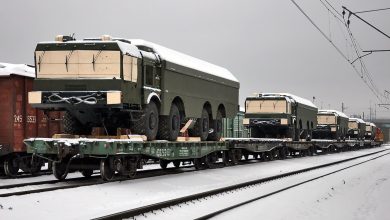
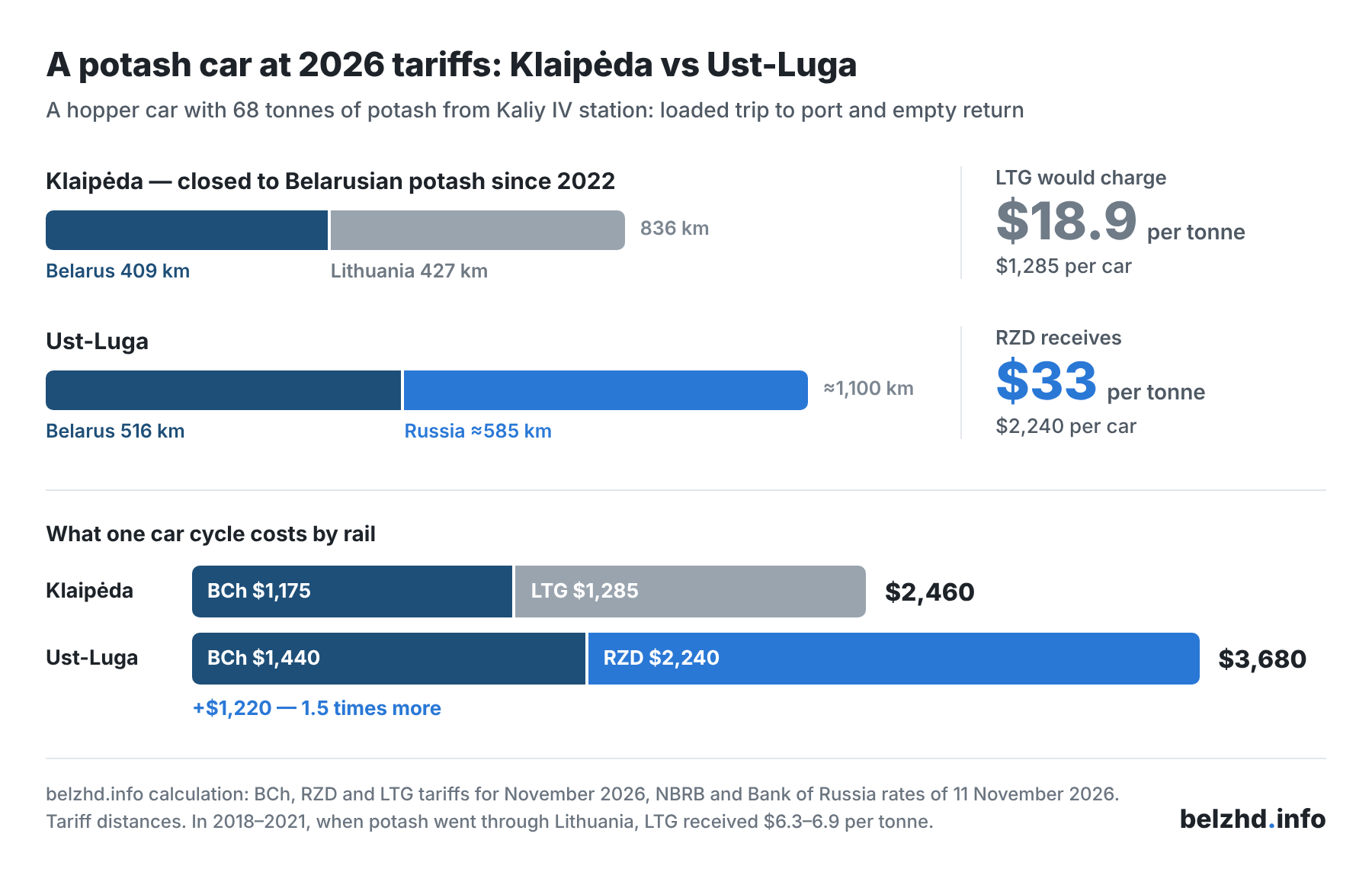
A hopper car carrying 68 tonnes of potash travels 1,100 km from Kaliy IV station in Soligorsk to Ust-Luga, 585 km of them in Russia. At November 2026 tariffs, Russian Railways (RZD) receives 185,000 Russian rubles ($2,240) for a round trip of such a car (to the port and back empty). Lithuanian Railways (LTG) would charge €1,144 ($1,285) for the same car to Klaipėda at its current tariff, and in 2018–2021, when the fertilizer went through Lithuania, it received less than $500 per car.
Klaipėda has been closed to Belarusian potash since February 1, 2022, and oil products began moving to Russian ports even earlier. Using Belarusian Railway (BCh) shipment data and November 2026 tariffs, we calculated what the new export logistics costs and who earns from it, and compared it with shipping to Klaipėda at current tariffs. Key points:
- In 2025, Belaruskali dispatched 8.68 million tonnes of potash fertilizers to Russian port railway stations, while Belarusian oil product shippers sent 2.59 million tonnes.
- RZD earns $327–383 million a year from this traffic, about a million dollars a day: $238 million from potash and $89–145 million from oil products, depending on whether RZD’s 2026 discounts apply. That is more than Lithuanian Railways, the BKT terminal and the Port of Klaipėda together earned from Belarusian potash transit before 2022 (€170 million a year).
- A tonne of potash costs $54 to move to Ust-Luga by rail; via Klaipėda, at current tariffs, it would cost $36, a third less. Of that $54, RZD receives $33: 1.7 times what LTG would charge today and five times what it received in 2018–2021. We could not establish any current discounts on potash to the North-West ports.
- For oil products the gap is smaller, but the Russian route is still more expensive: by $4–7 per tonne by rail and by $10–18 including transshipment. Transshipment in Russian ports costs 1.8–2.8 times as much as in Klaipėda. The Russian route could win only with RZD’s 2026 discount (a coefficient of 0.5 to the North-West ports), and that discount comes with a condition involving BCh tank cars.
- In early 2026, potash started going by more expensive routes, including to Murmansk, where the RZD tariff is almost double that to Ust-Luga.
The Route That No Longer Exists
Prior to 2022, nearly all Belarusian potash exports moved through Klaipėda. LTG reported carrying 10–11 million tonnes of Belaruskali cargo a year in 2018–2021. In the port it was handled by the BKT terminal, which has a capacity of 16 million tonnes a year and is 30% owned by Belaruskali.
In August 2021, the United States imposed sanctions on Belaruskali. In December, a Lithuanian government commission ruled LTG’s contract with the company a threat to national security. Since February 1, 2022, no potash has moved through Lithuania.
For oil products, the turn came a year earlier. On February 19, 2021, Belarus and Russia signed an agreement to transship up to 9.8 million tonnes of Belarusian oil products through Russian ports over three years. Poland’s Centre for Eastern Studies (OSW) noted at the time that transshipping a tonne of low-sulfur oil products in Ust-Luga cost 1,150 Russian rubles (€12.6) against €5.7 in Klaipėda, and that under the ship-or-pay formula Belarus pays for all contracted volumes even if it does not ship them.
Potash exports plunged after Lithuanian transit ceased. According to non-public Belstat statistics published by Nasha Niva, Belarus exported 12.3 million tonnes in 2021, 4.0 million in 2022, and 9.6 million in 2023. Traffic through the Ezerishche — Zaverezhye border crossing more than doubled: in 2021 BCh handed over 3.4 trains a day to RZD there, and in 2022 as many as 8.5 (details).
Where Cargo Goes Now
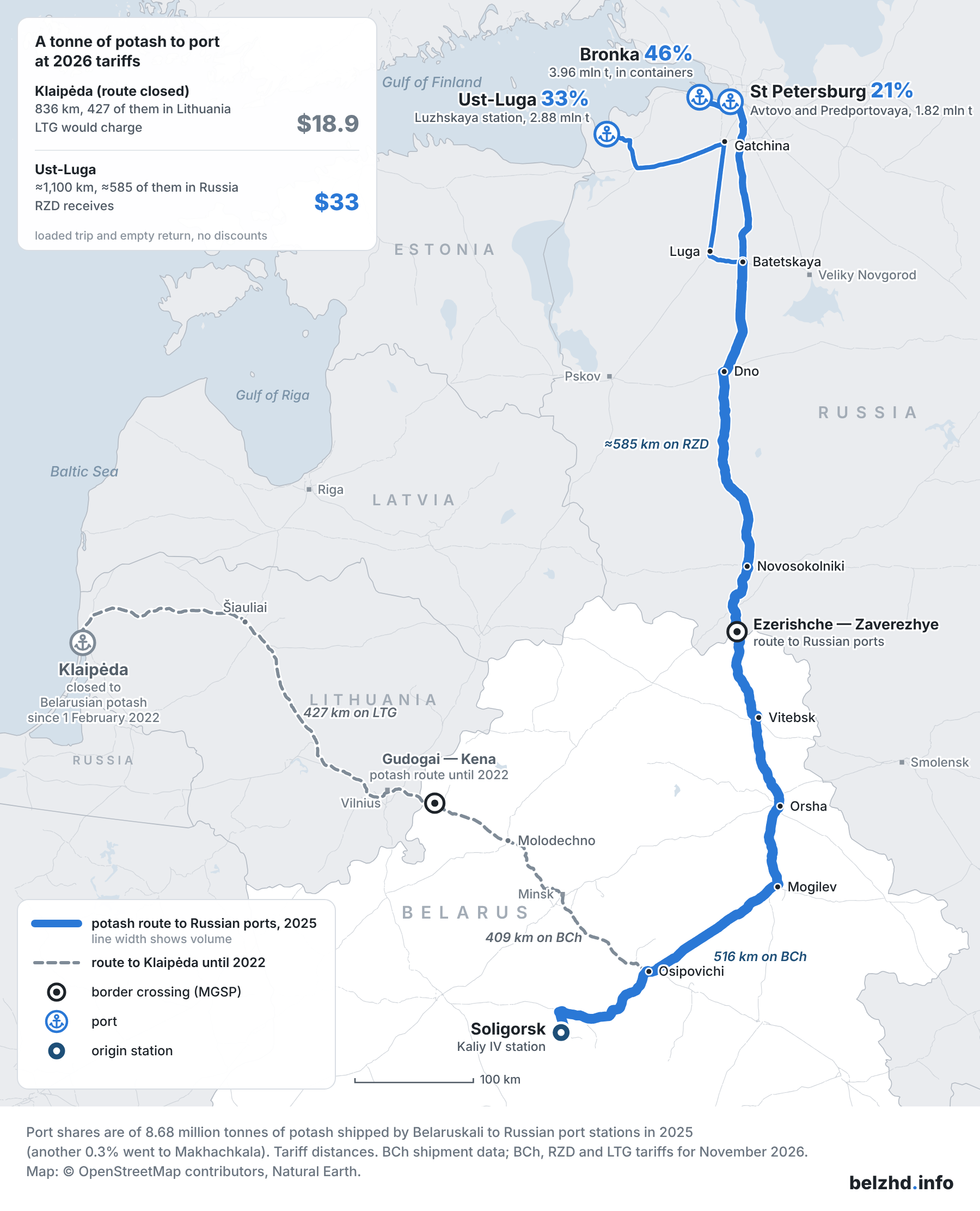
According to BCh shipment data, in 2025 Belaruskali dispatched 167,423 railcars carrying 8.68 million tonnes to Russian port railway stations — accounting for 86% of its total outbound volume. Bronka handled the largest share: 3.96 million tonnes in bulk containers (two per railcar), consigned to terminal operator LLC Fenix. Luzhskaya station in Ust-Luga received 2.88 million tonnes consigned to LLC Contuber; Predportovaya in St Petersburg handled 0.98 million tonnes addressed to Port Cargo Service JSC; and Avtovo took 0.84 million tonnes, a third of it in containers (the main terminal there is BazisPort). Combined with shipments from Grodno Azot, Gomel Chemical Plant, and other shippers, 9.08 million tonnes of fertilizers and related goods moved to Russian port stations.

Oil products accounted for 43,492 railcars carrying 2.59 million tonnes dispatched to Russian export stations — representing 64% of all rail exports of refined oil products, LPG, and petrochemicals from Belarus. Among them, Avtovo and Luzhskaya received 0.95 million tonnes each, Trusovo and Novolesnaya in Astrakhan handled 0.55 million tonnes, and Novorossiysk handled 82,000 tonnes.
Between January and April 2026, Belaruskali dispatched 3.24 million tonnes to Russian ports. Luzhskaya became the leading station by volume (1.46 million tonnes), pushing Bronka into second place with 1.15 million. In February and March, potash shipments resumed to Murmansk: 1,450 railcars carrying 98,600 tonnes.
Distance Comparison
The tariff distance from Kaliy IV station to Klaipėda is 836 km: 409 km on BCh to the Gudogai — Kena border crossing and 427 km on LTG to Draugystė station. To Luzhskaya in Ust-Luga, it is 1,100 km: 516 km on BCh to the Ezerishche — Zaverezhye border crossing and 585 km on RZD via Novosokolniki and Dno. To Murmansk, the distance reaches 2,450 km — 1,935 km of which lie across Russia.
| Potash destinations from Kaliy IV station | Border crossing | BCh route, km | Foreign route, km | Total km |
|---|---|---|---|---|
| Klaipėda, Draugystė station (pre-2022) | Gudogai — Kena | 409 | 427 (Lithuania) | 836 |
| Luzhskaya (Ust-Luga) | Ezerishche — Zaverezhye | 516 | approx. 585 | approx. 1,100 |
| Bronka (St Petersburg) | Ezerishche — Zaverezhye | 516 | approx. 525 | approx. 1,040 |
| Predportovaya (St Petersburg) | Ezerishche — Zaverezhye | 516 | approx. 515 | approx. 1,030 |
| Murmansk | Ezerishche — Zaverezhye | 516 | approx. 1,935 | approx. 2,450 |
| Tariff distances; Russian segments are rounded to the nearest 5 km. | ||||
The route to Ust-Luga is 264 km, or almost a third, longer than the route to Klaipėda, and the cargo now travels 585 km through another country instead of 427 km, 1.4 times more. The Belarusian leg has grown too: 516 km to the Russian border against 409 km to the Lithuanian one.
What a Rail Tariff Is
A tariff is what the railway charges for taking a loaded car to its destination and bringing it back empty. It covers all the railway’s work along the route. Track workers maintain the track, switches and bridges, signal technicians look after signaling and communications, and power engineers are responsible for the overhead line and traction substations. Station duty officers receive and dispatch trains, train dispatchers run them through their sections, and car inspectors check the cars. Locomotives need repairs at the depot, drivers and their assistants need wages, diesel locomotives need fuel and electric ones need power. General costs, from management to taxes, come on top.
The tariffs of both railways are built in a similar way. RZD’s are set out in Price List No. 10-01; BCh tariffs are approved by the Ministry of Antimonopoly Regulation and Trade (MART), most recently in August 2026. In both cases the charge is made up of components. The infrastructure component pays for the track, stations, signaling and traffic control, and the locomotive component for traction, that is, the locomotive and its crew. The car component is a charge for the car if it belongs to the railway itself. The amount depends on distance and cargo weight and is then multiplied by coefficients for the type of cargo, the type of car and who owns it. Belarusian potash and oil products travel across Russia in cars that do not belong to RZD, so its tariff is a charge for infrastructure and traction: for the loaded trip and, separately, for the empty return. The car charge does not always go to a third party, though: containers with potash to Bronka travel on flatcars of the Federal Freight Company (FGK), an RZD subsidiary. We did not include this charge in RZD’s revenue. BCh calculates its tariffs in Belarusian rubles, RZD in Russian rubles.
For the railway itself, the tariff is the main source of money. It pays for wages, fuel and electricity, repairs of track and rolling stock, and loan servicing. Most of the revenue comes from freight: according to expected figures for January–May 2023, freight brought BCh 1,192 million Belarusian rubles of its 1,358 million in transport revenue (details). Domestic passenger services lose money: revenue covers only 25–27% of their costs, and the rest, as BCh head Valery Verenich admitted in October 2025, is covered by freight.
That is why every railway wants cargo to travel over its own network. Since 2022, Belarusian fertilizers and oil products have covered half or more of their way to the sea in Russia, and most of the freight charge goes to RZD.
How Much Transport Costs
We calculated the cost of transport at BCh and RZD tariffs for November 2026 for a full cycle of a privately owned car, that is, the loaded trip to the port and the empty return. Tariffs were converted into US dollars at the rates of the National Bank of Belarus and the Bank of Russia on November 11. RZD’s 2026 discounts on oil products are not included in the main figures; their effect is shown in parentheses.
| Cargo and route | Km BCh / RZD | BCh, $/t | RZD, $/t | Total, $/t | RZD share |
|---|---|---|---|---|---|
| Potash fertilizers from Kaliy IV station | |||||
| hopper car — Luzhskaya (Ust-Luga) | 516 / 585 | 21.2 | 33.0 | 54.2 | 61% |
| hopper car — Predportovaya (St Petersburg) | 516 / 515 | 21.2 | 31.7 | 52.9 | 60% |
| flatcar with two bulk containers — Bronka | 516 / 525 | 9.3 | 22.2 | 31.5 | 70% |
| hopper car — Murmansk | 516 / 1,935 | 21.2 | 63.6 | 84.8 | 75% |
| Diesel fuel (in parentheses: if RZD 2026 discounts apply) | |||||
| Barbarov (Mozyr Refinery) — Luzhskaya | 515 / 585 | 15.8 | 47.9 (24.7) | 63.7 (40.6) | 75% |
| Barbarov — Avtovo (St Petersburg) | 515 / 515 | 15.8 | 46.4 (24.1) | 62.2 (39.9) | 75% |
| Novopolotsk — Luzhskaya | 203 / 585 | 8.3 | 47.9 (24.7) | 56.3 (33.1) | 85% |
| Novopolotsk — Avtovo | 203 / 515 | 8.3 | 46.4 (24.1) | 54.8 (32.4) | 85% |
| Novopolotsk — Kola (Murmansk Oblast) | 203 / 1,925 | 11.6 | 88.9 (45.8) | 100.6 (57.5) | 88% |
| Barbarov — Trusovo or Novolesnaya (Astrakhan) | 396 / 1,830 | 17.2 | 82.4 (67.8) | 99.6 (85.0) | 83% |
| Novopolotsk — Trusovo or Novolesnaya | 180 / 1,840 | 10.8 | 82.4 (67.8) | 93.2 (78.7) | 88% |
| Cost of rail transport to Russian ports, USD per tonne, at November 2026 tariffs. We could not establish any current discounts for potash. For diesel fuel, figures in parentheses include RZD 2026 discounts: 0.5 to the North-West ports and 0.75 on the loaded trip to the Caspian. Loads: 68 tonnes of potash per hopper car, 43 tonnes per car with two bulk containers, 65 tonnes of diesel fuel per tank car. The RZD tariff for oil products includes the cargo security charge. Shipments to Astrakhan cross the border at Osinovka — Krasnoye and Zaolsha — Rudnya, all others at Ezerishche — Zaverezhye. | |||||
A round trip of a potash hopper car to Ust-Luga costs $3,680. Of this, BCh receives 4,300 Belarusian rubles ($1,440) and RZD 185,000 Russian rubles ($2,240), or 61% of the rail charge. For diesel from Novopolotsk to St Petersburg and Ust-Luga, RZD receives 85% of the charge, and 88% to Astrakhan and Kola. In the end, of every dollar a shipper pays for rail transport, RZD gets 60 to 88 cents.
The tariff per tonne depends on the car. Potash goes to Bronka in containers: a car with two bulk containers holds 43 tonnes, a hopper car 68. But both railways charge much less for such a car: BCh $400 against $1,440 for a hopper car, RZD $950 against $2,160–2,240. So per tonne the tariff to Bronka is lower too: $31.5 on both railways against $53–54 in hopper cars to St Petersburg and Ust-Luga. Murmansk is the most expensive: $84.8 per tonne, of which RZD receives $63.6. For diesel, RZD charges $46–48 per tonne to St Petersburg and Ust-Luga, $89 to Kola and $82 to Astrakhan ($24–25, $46 and $68 with the 2026 discounts). Gasoline is lighter than diesel, so a tank car carries fewer tonnes and the cost per tonne is even higher.
If It Went via Klaipėda
Using November 2026 tariffs, we also calculated shipping to Klaipėda via the Gudogai — Kena border crossing. A round trip of a potash hopper car from Kaliy IV to Draugystė would cost $2,460: BCh would receive 3,500 Belarusian rubles ($1,175) and LTG €1,144 ($1,285). Per tonne, that is $36 against $54 to Ust-Luga and $53 to St Petersburg. The Lithuanian railway would get 52% of the rail charge; on the route to Ust-Luga, RZD receives 61%.
Only containers to Bronka are cheaper than Klaipėda by tariff ($31.5 per tonne). But the tariff does not include the containers themselves, FGK’s flatcars or the terminal’s work with them, and the same volume needs 1.6 times as many cars. So comparing efficiency on the tariff alone is not correct.
| Route | Km BCh / Foreign | BCh, $/t | Foreign, $/t | Total, $/t | Transit time, days |
|---|---|---|---|---|---|
| Potash in hopper cars, 68 tonnes | |||||
| Kaliy IV — Klaipėda (Draugystė) | 409 / 427 | 17.3 | 18.9 (LTG) | 36.2 | 12 |
| Kaliy IV — Luzhskaya (Ust-Luga) | 516 / 585 | 21.2 | 33.0 (RZD) | 54.2 | 20 |
| Kaliy IV — Predportovaya (St Petersburg) | 516 / 515 | 21.2 | 31.7 (RZD) | 52.9 | 18 |
| Diesel fuel in tank cars, 65 tonnes | |||||
| Barbarov — Klaipėda | 524 / 427 | 20.1 | 36.5 (LTG) | 56.6 | 12 |
| Barbarov — Luzhskaya | 515 / 585 | 15.8 | 47.9 (RZD) | 63.7 | 20 |
| Novopolotsk — Klaipėda | 283 / 414 | 14.4 | 36.5 (LTG) | 50.9 | 10 |
| Novopolotsk — Luzhskaya | 203 / 585 | 8.3 | 47.9 (RZD) | 56.3 | 16 |
| USD per tonne at November 2026 tariffs, loaded trip and empty return. Routes: to Klaipėda via the Gudogai — Kena border crossing, to Russian ports via Ezerishche — Zaverezhye. RZD’s 2026 discount on oil products is not included. LTG: base tariff without coefficients, converted from euros at the National Bank of Belarus rate of November 11, 2026. Transit time: standard delivery time. | |||||
For oil products the gap is smaller. For a tank car of diesel, LTG would charge €2,113 ($36.5 per tonne) at its current tariff, while RZD receives $47.9 to Ust-Luga. By rail, diesel to St Petersburg and Ust-Luga costs $4–7 per tonne more than via Klaipėda, and $10–18 more with the more expensive transshipment (see below). RZD’s 2026 discount could reverse the comparison: with a coefficient of 0.5, the Russian route would be $16–19 per tonne cheaper by rail and $6–12 cheaper including transshipment. But the discount is tied to a condition on BCh tank cars (see “Discounts”), and how widely it is applied in practice is not known.
How Much RZD Earns
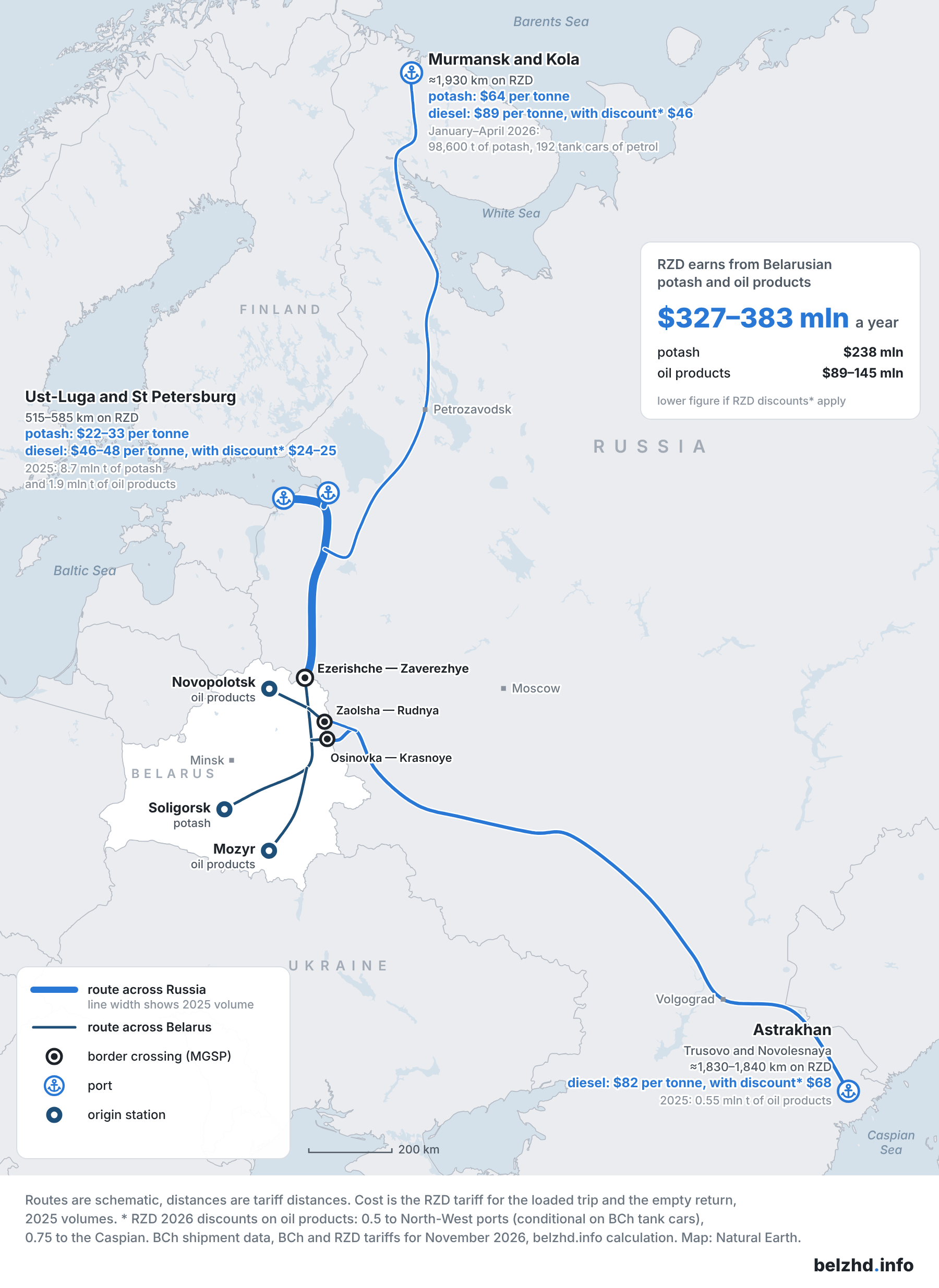
At 2025 volumes and November 2026 tariffs, RZD earns $383 million a year from carrying Belarusian potash and oil products. That is more than a million dollars a day. If RZD’s 2026 discounts apply to all oil products, the figure is $327 million.
| Station | Railcars | Tonnes | RZD, $ million |
|---|---|---|---|
| Belaruskali potash | |||
| Bronka | 91,992 | 3,955,656 | 87.7 |
| Luzhskaya | 42,293 | 2,875,924 | 94.9 |
| Predportovaya | 14,423 | 980,764 | 31.1 |
| Avtovo | 18,364 | 843,632 | 24.0 |
| Total potash | 167,072 | 8,655,976 | 237.7 |
| Oil products | |||
| Avtovo | 14,660 | 952,180 | 43.6 (21.8) |
| Luzhskaya | 16,865 | 947,257 | 50.8 (25.4) |
| Trusovo and Novolesnaya | 9,730 | 554,000 | 50.7 (41.5) |
| Total oil products | 41,255 | 2,453,437 | 145.2 (88.7) |
| Total | 208,327 | 11,109,413 | 382.9 (326.5) |
| RZD revenue at 2025 volumes and November 2026 tariffs. For oil products, figures in parentheses include RZD 2026 discounts. Weights are estimated. Potash to Avtovo in gondola cars is calculated at the tariff to Predportovaya, in containers at the tariff to Bronka. Fuel oil is calculated at the fuel oil tariff, gasoline and gasoil at the diesel tariff. The security charge for gasoline and diesel (another $3.2 million) is not included in revenue. Makhachkala, Novorossiysk, other stations and fertilizers from other shippers are not included. | |||
RZD earns 1.8 times more than BCh from potash: $238 million against $133 million. For oil products the gap is even bigger: RZD receives $89–145 million against BCh’s $40 million, 2.2–3.6 times more, depending on RZD discounts.
At the same tariffs, RZD would have received $95 million from potash in January–April 2026. If the pace holds, the year will bring $285 million, almost $50 million more than in 2025: the fertilizer has been going less often in containers to Bronka and more often to Luzhskaya and Murmansk, where the tariff per tonne is higher.
What Lithuania Used to Earn
LTG data cited by the ELTA news agency in May 2026 show that in 2018–2021 the company earned €60 million a year from carrying Belaruskali cargo. That is €5.5–6 per tonne, or $6.3–6.9 at the average exchange rate of those years. Since the transit stopped, the Klaipėda port authority has been missing out on €14 million in revenue a year. In 2021, the BKT terminal recorded €96.1 million in revenue and €16.1 million in net profit.
Together that is €170 million a year, almost $200 million. RZD now receives $238 million from potash alone, and from smaller volumes: 8.7 million tonnes against 10–11 million.
RZD charges $33 per tonne of potash to Ust-Luga and $27.5 on average across all destinations, four to five times what LTG received in 2018–2021. At its current tariff, LTG would charge $18.9 per tonne in a hopper car, almost three times as much as then. Why the gap is so large is not clear from open data: it may be tariff increases or the terms of the contract with Belaruskali. LTG is probably responding to the market and bringing its tariffs closer to Russian ones.
Yet even at its current tariff, the 8.7 million tonnes of 2025 would have brought LTG $164 million, $74 million less than RZD receives; at 2018–2021 rates the difference would be about $180 million. The whole rail journey via Klaipėda would cost $313 million at current tariffs, against $371 million via Russian ports.
Transshipment
Transshipment comes on top of the rail charge. Argus publishes rates for oil products: as of May 1, 2025, Ust-Luga charged 1,345–1,540 Russian rubles per tonne for light oil products and 1,760–1,980 rubles for heavy ones, and St Petersburg 1,050–1,150 and 1,350–1,450 rubles (Argus Neftetransport, May 2025). At November 11, 2026 exchange rates, that equals $16–19 and $21–24 in Ust-Luga, and $13–14 and $16–18 in St Petersburg.
In our 2024 analysis, transshipment in Klaipėda cost $7 per tonne for light oil products and $8.65–8.70 for heavy products. Russian terminals charge 1.8–2.8 times more. At 2025 volumes (Avtovo receives mostly fuel oil, Luzhskaya gasoline), that is another $16–19 million a year.
We could not find publicly available rates for potash transshipment in Russian ports. For reference, in 2021 BKT earned an average of €8.7 per tonne handled. In July 2023, at a meeting with Lukashenka, First Deputy Prime Minister Nikolai Snopkov admitted that transshipment had become “two to five times” more expensive and rail transport along the longer route “about 2 to 2.5 times” more expensive.
Discounts
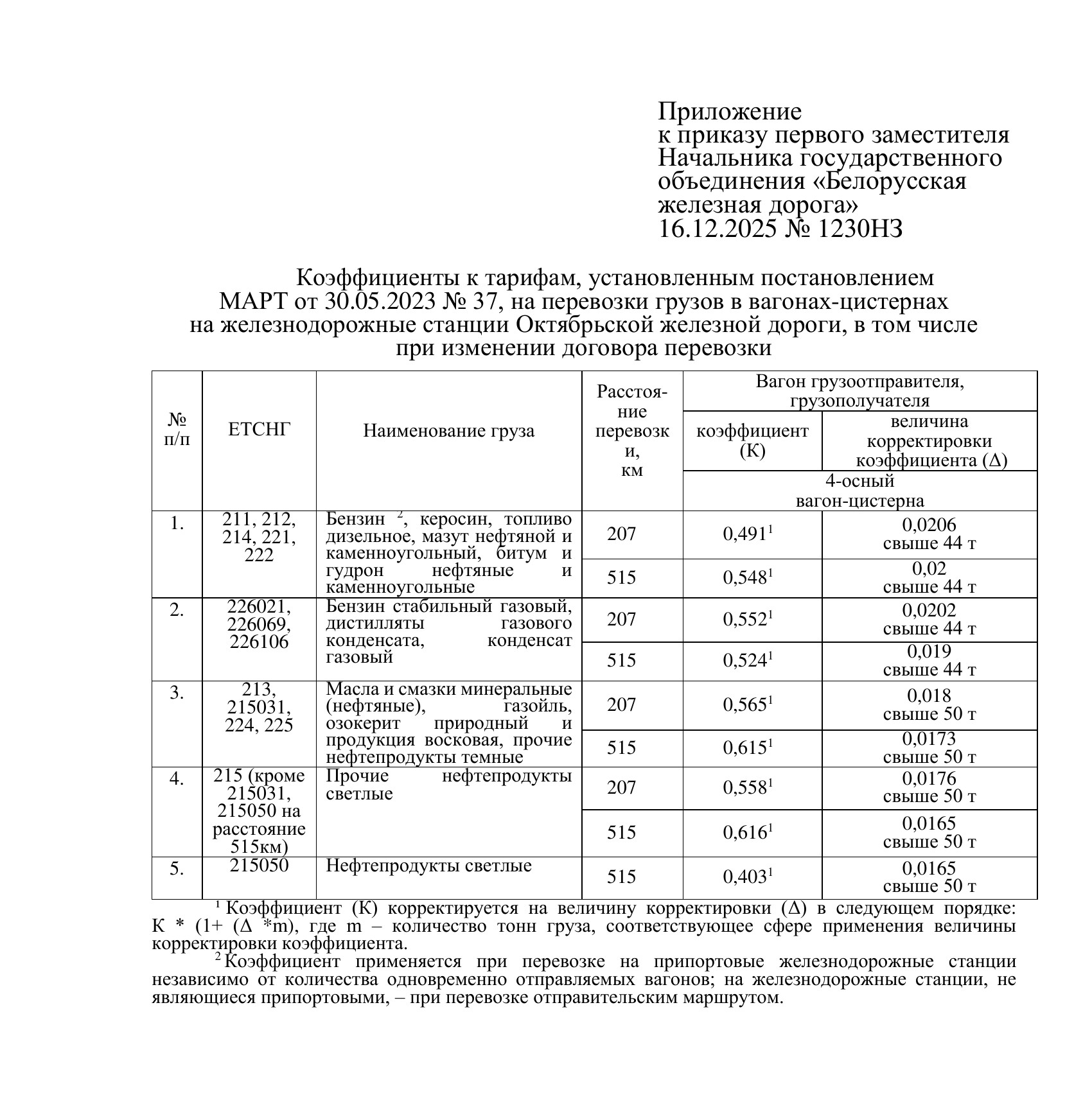
RZD cuts tariffs for Belarusian cargo selectively. For 2026, it set a coefficient of 0.5 for oil products from Belarus via Zaverezhye to the port stations of the Oktyabrskaya Railway in St Petersburg, Ust-Luga and the Murmansk region. It applies to both the loaded trip and the return of empty tank cars, but on one condition: BCh does not charge for the use of its common-fleet tank cars. How widely this discount is applied is not known, so we do not include it in the main figures. Where it applies, RZD’s charge for diesel to St Petersburg and Ust-Luga falls from $46–48 to $24–25 per tonne. OSW wrote that a similar 50% discount had applied to Belarusian oil products since 2016.
On the Caspian route, RZD maintained the 0.75 coefficient for 2026 on oil products from Belarus to port stations (Trusovo, Novolesnaya, Makhachkala and others). Such discounts have been in force since March 2023. For fertilizers on this route, the 2026 discount is 15%.
BCh has also cut its tariff for oil products to the port stations of the Oktyabrskaya Railway: for the loaded trip from Mozyr it is about a quarter below the standard one, and almost a third below from Novopolotsk. Our calculation takes this into account. Back in June 2024, BCh granted a 55% discount on potash to the ports of the Murmansk region and 40% on liquid nitrogen fertilizers to the ports of St Petersburg, officially to attract additional volumes.
We could not establish any current RZD discounts on potash to the North-West ports. In 2023–2024 there was a 10% discount to the stations of the Big Port of St Petersburg and 40% via the border crossings with Kazakhstan, but no fertilizer went that way in 2023 (details). The Murmansk route is the most expensive: the RZD tariff is $64 per tonne against $33 to Ust-Luga. With discounts on its own tariff, BCh in effect pays for part of the extra cost of these routes.
Railcars and Time
A longer route also means more cars. The standard delivery time to Klaipėda is 10–12 days, to the ports of St Petersburg and Ust-Luga 16–20, to Bronka 24, to Astrakhan 24–26 and to Murmansk 32. All this time the car is busy, and then it still has to come back empty.
The container scheme to Bronka is cheaper by tariff but needs more cars: a car carries two bulk containers with 43 tonnes of fertilizer, while a hopper car takes 68 tonnes. For every million tonnes, that is 23,000 cars against 15,000 hopper cars. The containers themselves and their handling at the terminal are not included in the tariff.
Who Pays for the Infrastructure
To accommodate Belarusian freight, both national railways are rebuilding port railway access routes. In 2024, Kommersant reported that developing the Batetskaya — Bronka section would cost RZD 156.3 billion rubles, including 90.5 billion for a 75 km southwestern bypass of St Petersburg with Vladimirskaya station. The deadline is 2028. At the time, RZD’s investment program to 2026 allocated only 15.1 billion rubles to the port approaches in this direction. Without ship-or-pay commitments from Belarus, such an expansion looks like a gamble; Belarusian investment in Bronka’s infrastructure could serve as a guarantee.
BCh is investing too: in 2023 it spent almost $10 million on repairing the routes to the North-West ports, and it estimated the electrification of the line from Zhlobin via Ezerishche to the Russian border at $280 million (details).
What Next
The Murmansk route is set to expand. In Lavna near Murmansk, the Arctic Gate Marine Terminal, owned by the Belarusian company Logistic Energy, plans to launch a complex with a capacity of 25–30 million tonnes a year in 2028. In January–April 2026, Logistic Energy already sent 192 tank cars of gasoline via Kola station. RZD’s base tariff to Kola stands at $89 per tonne for diesel — almost double the Ust-Luga rate — or $46 with the 0.5 discount.
In December 2025, the United States issued a general license for transactions with Belaruskali, and in March 2026 it announced the lifting of sanctions. Transit through Klaipėda, however, remains closed. In July 2025, Lithuanian Prime Minister Gintautas Paluckas stated that Lithuania’s stance remained unchanged and that no substantive talks on resuming transit were taking place. In December 2025, the director of Klaipėda Port noted that the port stood ready to resume handling Belarusian fertilizers should a political decision be made. Around the same time, an adviser to the President of Lithuania allowed that the question of the route could come up if the potash went to the United States, and that a decision could be linked to a larger American military presence. In January 2026, however, Lithuanian Foreign Minister Kęstutis Budrys said that transit is legally impossible while EU sanctions are in force.
In February 2026, EU sanctions against Belarus were extended until February 28, 2027, and Belaruskali was not removed from them. In late October, Politico reported that US special envoy John Cole was still trying to persuade Lithuanian diplomats to let Belarusian potash through Klaipėda, and that Washington had considered Riga as a fallback. Budrys again said that EU sanctions prohibit both imports and transit.
Meanwhile, RZD tariffs keep rising: they were indexed by 13.8% on December 1, 2024, by another 10% on December 1, 2025, and by 8.5% on October 1, 2026. As long as the route through Lithuania stays closed, the bill for bypassing Klaipėda will grow along with them.
How We Calculated
- Volumes are taken from BCh shipment data for 2025 and January–April 2026. Tariffs are for November 2026; exchange rates of the National Bank of Belarus and the Bank of Russia are as of November 11, 2026.
- To compare transshipment per tonne, we took the midpoint of the Argus rate ranges.
- If BCh’s 2024 discount on potash to the ports of the Murmansk region still applies, transport there costs less than shown in the table.
- Not included: Makhachkala, Novorossiysk and other stations, fertilizers from other shippers (about 5% of port tonnage), the services of forwarders and car operators (including FGK’s charge for flatcars to Bronka), station operations, port storage and sea freight.
Related coverage:
2024 Rail Tariffs: Deepening Belarus’s Export Logistics Losses;
The Illusory Benefits of New Belarusian Fertilizer Export Routes;
The Real Drivers Behind BCh’s New Tariff Discounts.